
Ray tracing has become one of the most important technologies in modern gaming because it makes virtual worlds look more realistic. From natural lighting and accurate reflections to detailed shadows, this technology can transform the visual quality of a game. However, ray tracing also requires considerable graphics processing power, so choosing the right graphics card is essential for players who want excellent performance without sacrificing image quality. 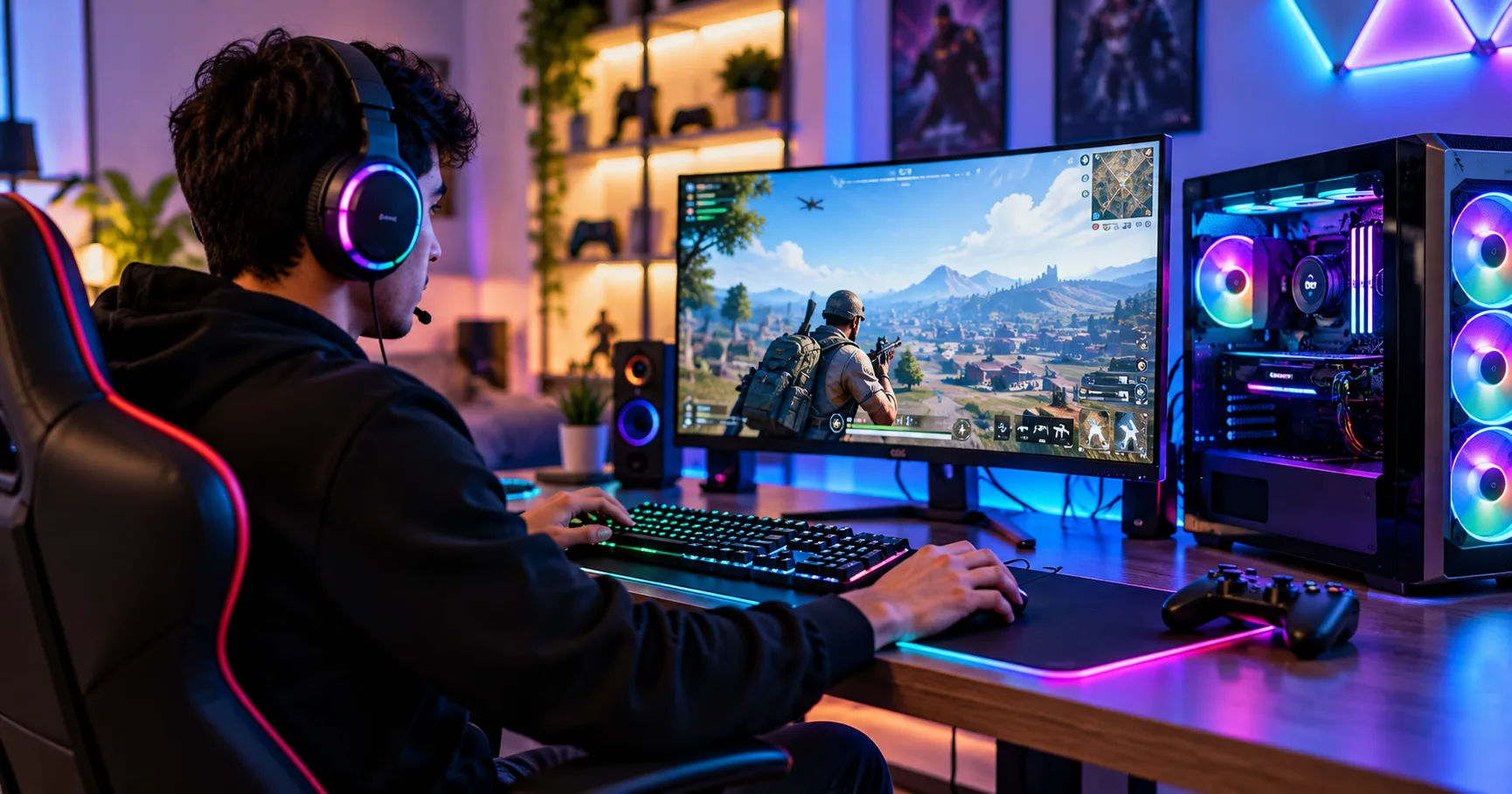 The NVIDIA GeForce RTX 5090 is designed for enthusiasts who want high-end gaming performance, advanced rendering capabilities, and access to the latest graphics technologies. For gamers exploring the rtx 5090 uae market, this graphics card is particularly interesting because it combines powerful hardware with NVIDIA's modern ray-tracing and AI-powered rendering features.
Whether you enjoy cinematic single-player adventures, competitive gaming, or demanding games with full path tracing, the RTX 5090 offers substantial capabilities. However, its performance depends on factors such as resolution, game optimization, processor choice, cooling, and the graphics settings you use.
Understanding these factors will help you decide whether this premium graphics card is the right investment for your gaming setup.
Ray Tracing in Modern Gaming
Ray tracing is a rendering technique that simulates how light interacts with objects in a virtual environment. Traditional rendering methods often use approximations to create lighting and reflections. Ray tracing calculates light behavior more directly, allowing games to produce more realistic visual effects.
For example, a traditional game might display a reflection using a prepared image or a simplified rendering technique. With ray tracing enabled, the game can calculate reflections based on objects and light sources within the scene.
This approach can create more convincing environments, especially in games featuring glass buildings, wet streets, reflective surfaces, and complex indoor lighting.
What Makes Ray Tracing Different?
Ray tracing can improve several visual elements.
-
Realistic reflections: Mirrors, windows, water, and polished surfaces can reflect surrounding objects more accurately.
-
Natural shadows: Shadows can respond more realistically to the size, position, and distance of light sources.
-
Improved global illumination: Light can bounce between surfaces, making indoor and outdoor environments feel more natural.
-
Better ambient lighting: Objects can receive more convincing indirect light from nearby surfaces.
-
Greater environmental detail: Lighting effects can make materials, textures, and architectural details appear more believable.
These improvements require additional processing power. Consequently, enabling ray tracing can reduce frame rates significantly on less powerful graphics cards.
A high-end GPU like the RTX 5090 is designed to handle these demanding workloads more effectively.
Ray Tracing Versus Path Tracing
Ray tracing and path tracing are related technologies, but they are not identical.
Ray tracing can be applied selectively to reflections, shadows, or other lighting effects. Path tracing uses a more comprehensive approach to simulate how light travels and interacts throughout a scene.
Path tracing can produce exceptionally realistic results, but it is generally more demanding.
The RTX 5090 is particularly attractive to gamers interested in path-traced games because its powerful hardware and AI-assisted rendering technologies can help maintain playable performance at demanding resolutions.
Why the RTX 5090 Is Powerful for Ray Tracing
The NVIDIA GeForce RTX 5090 belongs to the Blackwell generation of graphics cards. It is built for demanding gaming, creative applications, and advanced graphics workloads.
Its architecture includes dedicated ray-tracing hardware, AI-focused processing capabilities, and substantial graphics memory.
These components work together to improve performance in games that use complex lighting calculations.
Dedicated Ray-Tracing Hardware
Modern NVIDIA graphics cards include specialized hardware designed to accelerate ray-tracing operations.
These processing units handle tasks associated with tracing rays through a scene and determining how they interact with objects.
The RTX 5090 features fourth-generation RT cores, which help accelerate supported ray-tracing workloads.
Instead of relying entirely on general-purpose graphics processing, the card can use these specialized units to handle important parts of the rendering process more efficiently.
This is particularly beneficial in games with complex reflections, multiple light sources, and extensive path-tracing effects.
High Graphics Processing Capability
Ray tracing becomes more demanding as resolution increases.
Rendering a game at 4K requires substantially more pixels than rendering it at 1080p. When ray tracing is enabled, the GPU must also perform additional calculations for lighting and reflections.
The RTX 5090 is designed to handle demanding rendering workloads, making it suitable for players who want high-resolution graphics and advanced visual effects.
However, actual performance varies by game. Some titles have highly optimized ray-tracing implementations, while others require significantly more processing power.
Large Graphics Memory Capacity
The RTX 5090 includes 32GB of GDDR7 graphics memory.
This capacity can be useful for demanding games, high-resolution textures, complex rendering workloads, and certain creative applications.
Ray tracing itself does not automatically require enormous amounts of memory in every game. Nevertheless, combining high-resolution textures, detailed environments, and advanced lighting can increase memory requirements.
Having substantial VRAM gives the card considerable flexibility for demanding gaming workloads.
How Well Does RTX 5090 Handle Ray Tracing at Different Resolutions?
Resolution has a major influence on ray-tracing performance. The same game and graphics settings can produce very different frame rates at 1080p, 1440p, and 4K.
The RTX 5090 has enough processing power to make high-resolution ray tracing a practical option in many modern games, although the most demanding settings can still require additional performance optimization.
Ray Tracing at 1080p
At 1080p, the RTX 5090 has considerable graphics processing headroom in many games.
Players can generally use high or ultra graphics settings while enabling supported ray-tracing effects. In less demanding titles, performance may be high enough to support very high refresh rates.
However, a powerful GPU is not always fully utilized at this resolution.
The processor can become a limiting factor, particularly in competitive games that generate very high frame rates. Therefore, pairing the card with a capable CPU is important if you want to benefit from a high-refresh-rate monitor.
For most buyers choosing a graphics card primarily for 1080p gaming, the RTX 5090 is more powerful than necessary.
Ray Tracing at 1440p
At 1440p, the RTX 5090 offers an appealing balance between image quality and performance.
This resolution provides greater detail than 1080p without requiring the same pixel workload as 4K. It is a strong option for gamers who want sharp visuals, detailed environments, and advanced lighting effects.
The card should handle ray tracing comfortably in many games at this resolution, although demanding path-tracing implementations may still benefit from DLSS.
A high-refresh-rate 1440p monitor can also help players enjoy smooth gameplay while retaining excellent image quality.
For enthusiasts who want both visual quality and responsiveness, 1440p is a practical choice.
Ray Tracing at 4K
Four-kilopixel gaming is one of the most compelling uses for the RTX 5090.
At 3840 × 2160 resolution, games display highly detailed images, but the GPU must render more than eight million pixels per frame.
Adding ray tracing increases the workload further.
The RTX 5090 is designed to handle 4K gaming with demanding graphics settings, including ray tracing in many supported games. Nevertheless, performance will depend on the title, the intensity of its lighting effects, and whether upscaling or frame generation is enabled.
For gamers who want cinematic graphics on a large monitor or television, 4K is an excellent application for this class of GPU.
What About 8K Ray Tracing?
The RTX 5090 can also be used for experimental or specialized 8K gaming setups. However, native 8K rendering with maximum ray tracing is substantially more demanding than 4K.
DLSS and other supported performance features may be necessary to achieve a practical frame rate.
For most gamers, 4K with high-quality ray tracing is a more balanced target than native 8K with every visual setting maximized.
How DLSS Improves Ray-Tracing Performance
One of the most important advantages of modern NVIDIA graphics cards is Deep Learning Super Sampling, commonly known as DLSS.
DLSS uses AI-based techniques to improve performance while preserving image quality.
Rather than rendering every pixel at the display's full resolution, supported games can render internally at a lower resolution and reconstruct a higher-resolution image.
This reduces the rendering workload and can help maintain smoother gameplay.
DLSS Super Resolution
DLSS Super Resolution reconstructs a higher-resolution image from a lower-resolution rendering.
For example, a game displayed at 4K may use a lower internal rendering resolution. The reconstruction process helps produce a detailed final image while reducing the number of pixels that must be rendered directly.
This can be particularly valuable when ray tracing is enabled because the GPU has more resources available for complex lighting effects.
Image quality depends on the game, the selected DLSS mode, and the implementation.
DLSS Frame Generation
Frame Generation creates additional frames using AI-assisted techniques and information from the rendering pipeline.
This can increase the displayed frame rate in supported games, making animations appear smoother.
However, generated frames are not equivalent to traditionally rendered frames in every respect. The underlying simulation and input responsiveness do not necessarily improve in direct proportion to the displayed frame rate.
For competitive gaming, responsiveness remains important. For cinematic single-player games, frame generation can be particularly useful.
Multi Frame Generation
The RTX 5090 supports NVIDIA DLSS 4 Multi Frame Generation, which can generate multiple additional frames for each traditionally rendered frame in supported implementations.
This can significantly increase displayed frame rates in compatible games.
However, the results depend on the base frame rate, game support, image quality, and latency. A very high displayed frame rate does not automatically mean the game has the same responsiveness as a game rendering every frame conventionally.
For demanding path-traced titles, Multi Frame Generation can be a valuable tool for making advanced visual effects more practical.
Which Games Benefit Most From RTX 5090 Ray Tracing?
Not every game uses ray tracing in the same way. Some titles use it for a few reflections or shadows, while others implement more extensive lighting systems.
The RTX 5090 is especially attractive for games that combine high-resolution rendering with advanced lighting effects.
Cyberpunk 2077
Cyberpunk 2077 is well known for its demanding graphics settings and advanced ray-tracing options.
Ray-traced reflections, shadows, and lighting can make Night City appear more realistic. The game's path-tracing mode places an even greater workload on the GPU.
The RTX 5090 is well suited to exploring these advanced visual settings, particularly at 4K with DLSS and compatible frame-generation features.
Players should still adjust settings according to their preferred balance between image quality, latency, and frame rate.
Alan Wake 2
Alan Wake 2 features detailed environments and demanding lighting effects.
Ray tracing can improve the atmosphere of dark interiors, reflective surfaces, and carefully designed environments. More advanced rendering options can make the game especially demanding.
The RTX 5090 offers substantial graphics power for experiencing these effects at high resolutions, although performance depends on the selected settings and rendering mode.
Black Myth: Wukong
Black Myth: Wukong uses demanding graphics features and offers advanced ray-tracing options.
Its detailed environments, reflective surfaces, and complex visual effects can place considerable pressure on a GPU.
The RTX 5090 is an attractive choice for players who want to explore these settings while targeting high resolutions.
Minecraft With Ray Tracing
Supported versions and editions of Minecraft can use ray tracing to produce realistic lighting, reflections, and shadows.
The difference can be dramatic compared with traditional rendering, especially in carefully designed worlds with reflective materials and detailed lighting.
Performance varies considerably according to world complexity, resource packs, resolution, and rendering settings.
The RTX 5090 provides substantial headroom for experimenting with these visual improvements.
RTX 5090 UAE: What Buyers Should Consider Before Purchasing
For buyers researching the rtx 5090 uae market, gaming performance is only one part of the purchasing decision.
A high-end graphics card must also fit the computer case, power supply, cooling system, and budget.
Considering these requirements before purchasing can prevent compatibility problems and unexpected expenses.
Check the Graphics Card Dimensions
The RTX 5090 Founders Edition and different partner models can vary in size and cooling design.
Many high-performance cards occupy several expansion slots and require considerable space inside the case.
Before buying, check the exact model's length, width, thickness, and power-connector clearance.
A case that accommodates a standard graphics card may not necessarily fit a large premium model comfortably.
Good airflow is equally important because a powerful GPU produces substantial heat during demanding gaming sessions.
Choose a Suitable Power Supply
The RTX 5090 has a high power requirement. NVIDIA specifies a total graphics power of approximately 575 watts for its reference specifications and recommends a 1,000-watt system power supply, although the actual requirement depends on the complete system and the specific card.
A high-quality power supply with appropriate connectors is essential.
The processor, storage devices, cooling equipment, and other components also consume power. Therefore, selecting a power supply should involve evaluating the entire computer rather than the GPU alone.
Follow the graphics card manufacturer's requirements, use compatible power cables, and ensure that connectors are seated correctly.
Consider Cooling and Airflow
Ray tracing can keep the GPU under substantial load for extended periods.
A suitable case, well-positioned fans, and an effective graphics card cooler help maintain stable operation.
Poor airflow can lead to higher temperatures, increased fan noise, and reduced boost performance under some conditions.
In hot environments, including during warmer periods in the UAE, room temperature and case airflow deserve particular attention.
Air conditioning can help maintain a comfortable gaming environment, but good internal airflow remains necessary.
Verify Warranty and Regional Availability
When exploring the rtx 5090 uae market, compare warranty terms, seller reputation, and the exact model being offered.
Check whether the product is new, whether the warranty is supported locally, and whether the seller provides a clear return policy.
Prices and availability can change quickly for premium graphics cards. Compare the total cost rather than relying on the lowest advertised price alone.
A slightly more expensive product from a reputable seller may offer better support and a more straightforward warranty process.
Is RTX 5090 Worth It for Ray Tracing?
Whether the RTX 5090 is worth buying depends on your gaming priorities and budget.
For enthusiasts who want advanced ray tracing at 4K, the card offers a compelling combination of dedicated ray-tracing hardware, powerful graphics processing, large VRAM capacity, and modern AI rendering features.
However, it is not the most economical option for every player.
Who Should Buy It?
The RTX 5090 is particularly suitable for:
-
Gamers who want to play demanding titles at 4K with advanced ray tracing.
-
Enthusiasts who enjoy experimenting with path tracing and maximum graphics settings.
-
Users who need substantial GPU performance for creative work alongside gaming.
-
Players building a premium system intended to remain capable for several years.
-
Users with high-refresh-rate 4K monitors who want strong performance in demanding games.
For these buyers, the card's performance capabilities can justify its premium positioning.
Who Might Prefer a Less Expensive GPU?
A less expensive graphics card may be a better choice if you primarily play esports titles, use a 1080p monitor, or do not care about advanced lighting effects.
Many games run well without ray tracing, and traditional rasterization can still produce excellent graphics.
If your main goal is a high frame rate in competitive titles, spending more on a balanced system, a high-refresh-rate monitor, or other components may offer greater practical value.
Likewise, a lower-tier GPU may be more appropriate if buying the RTX 5090 would require sacrificing essential components or exceeding your budget.
Is It Better Than Turning Ray Tracing Off?
Ray tracing improves visual realism, but it is not essential for enjoying a game.
Some players prefer the improved atmosphere and reflections. Others prioritize higher frame rates, lower latency, and competitive responsiveness.
The RTX 5090 gives enthusiasts more flexibility to experiment with demanding visual settings. However, the best configuration remains the one that suits your preferences.
For cinematic games, advanced ray tracing may be worth the performance cost. For competitive multiplayer games, traditional rendering with carefully selected settings may provide a better experience.
Tips for Getting the Best Ray-Tracing Performance
Even a powerful GPU benefits from sensible configuration.
Update Graphics Drivers
Install stable, current NVIDIA graphics drivers to receive game-specific optimizations, bug fixes, and support for newer graphics features.
For major game releases, check whether an appropriate driver update is available.
Balance Ray-Tracing Settings
Maximum settings are not always necessary to achieve excellent visuals.
If performance is lower than expected, consider reducing demanding ray-tracing options while keeping the effects that make the biggest visual difference.
For example, you might retain high-quality reflections while lowering another lighting setting.
Testing individual options makes it easier to identify which changes deliver the best balance.
Use DLSS When Appropriate
In supported games, DLSS Super Resolution can improve performance while maintaining attractive image quality.
Frame Generation may help in single-player titles where smooth visual presentation is a priority.
However, assess image quality and input latency rather than relying exclusively on the displayed frame-rate number.
Monitor Temperatures and Performance
Use reliable monitoring software to check GPU temperature, utilization, clock speeds, and power consumption.
If performance drops unexpectedly, investigate cooling, driver issues, background applications, and CPU limitations.
A well-configured system helps the RTX 5090 deliver consistent results during extended gaming sessions.
Pair It With a Suitable Processor and Monitor
A powerful GPU works best when the rest of the system is appropriately balanced.
A capable processor helps prevent bottlenecks, particularly at lower resolutions and very high frame rates.
A high-quality 4K monitor can showcase the detailed images that the card is designed to produce. Features such as variable refresh rate and a suitable refresh rate can also improve the gaming experience.
Conclusion
The RTX 5090 is an exceptionally capable graphics card for ray tracing, making it a strong option for gamers who want realistic lighting, detailed reflections, accurate shadows, and advanced path-traced effects. Its dedicated ray-tracing hardware, 32GB of GDDR7 memory, powerful Blackwell architecture, and support for modern DLSS technologies make it particularly appealing for demanding games at 1440p and 4K.
Its biggest advantage is the flexibility it offers. Players can explore advanced graphics settings, experiment with path tracing, and use AI-assisted rendering features to improve performance in supported titles. While the most demanding games may still require DLSS, careful settings adjustments, or frame generation, the RTX 5090 provides considerable processing power for high-end gaming.
For buyers researching the rtx 5090 uae market, the decision should also include power requirements, case compatibility, cooling, warranty coverage, and the total system cost. A suitable power supply, effective airflow, and a capable processor are important for building a reliable gaming PC around this graphics card.
Ultimately, the RTX 5090 is best suited to enthusiasts who value exceptional visual quality and want to experience modern ray tracing with fewer compromises. It may be unnecessary for casual gaming or lower-resolution displays, but for players who want a premium 4K gaming experience with advanced lighting effects, it is an excellent choice.
