
Choosing the right artwork file is an important step when working with Embroidery Digitizing Services. The quality and format of your original artwork can affect how easily it can be converted into an embroidery-ready design. While professional digitizers can often work with many file types, some formats are much easier to edit and process than others.
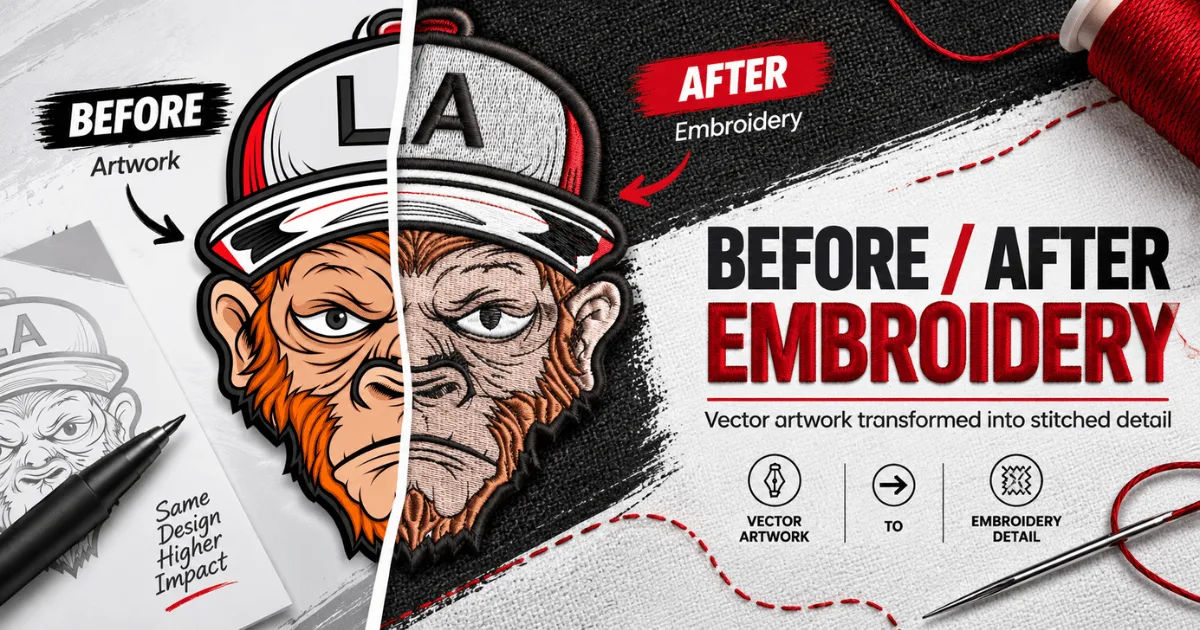
Businesses, clothing brands, sports teams, schools, and individuals often have logos or artwork saved in different formats. Understanding which files are accepted can save time and prevent unnecessary artwork adjustments.
This guide explains the most common file formats accepted by embroidery digitizers, which formats are preferred, what information you should provide, and how to prepare artwork for the best possible embroidery result.
Why File Format Matters for Embroidery
Embroidery machines do not read ordinary image files in the same way that computers or design software do. A regular image shows pixels, shapes, colors, and lines, but an embroidery machine needs instructions for creating stitches.
Digitizing software converts artwork into a stitch file. This process determines stitch types, stitch direction, density, underlay, sequencing, and other technical details.
Because of this, the original artwork is used as a reference by the digitizer. A clear and editable file can make the digitizing process faster and more accurate.
Professional Embroidery Digitizing Services may accept almost any recognizable artwork, but the amount of editing required can vary significantly between formats.
Common File Formats Accepted by Embroidery Digitizers
There is no single file format that every digitizer requires. However, several common formats are widely accepted.
JPEG Files
JPEG, or JPG, is one of the most common image formats.
Many customers have logos saved as JPEG files because they are widely supported and easy to create. A high-resolution JPEG can provide useful information about colors, shapes, text, and overall design structure.
However, JPEG files are made from pixels. If the image is very small or blurry, the digitizer may have difficulty identifying fine details.
A high-resolution JPEG is therefore much better than a compressed or low-quality version.
PNG Files
PNG files are also commonly accepted by Embroidery Digitizing Services.
PNG is particularly useful when artwork has a transparent background. This allows the digitizer to focus on the actual logo or artwork instead of removing a colored background.
PNG files can preserve sharp edges better than heavily compressed JPEG images. They are often a good choice for logos, icons, and simple graphics.
For the best results, provide a large PNG with clear edges whenever possible.
PDF Files
PDF is another useful format for embroidery artwork.
A PDF may contain vector artwork, text, images, or a combination of these elements. If the PDF contains vector graphics, it can provide excellent information for creating an embroidery design.
However, not every PDF is created in the same way. Some PDFs contain only a low-resolution image placed inside the document.
For this reason, simply sending a PDF does not automatically mean the artwork will be easy to digitize.
AI Files
AI files are Adobe Illustrator files.
They are commonly used by professional graphic designers because they can contain vector artwork. Vector graphics are made from mathematical paths rather than fixed pixels.
This allows artwork to be resized without losing sharpness.
An AI file can be especially helpful when a logo contains clean shapes, lettering, or detailed vector artwork. When available, this is often one of the most useful source files for a digitizer.
EPS Files
EPS is another popular vector format.
Many professional logos are created and stored as EPS files. They can preserve shapes, outlines, and other design elements that help a digitizer understand the original artwork.
If you have an EPS version of your logo, sending it can reduce the amount of manual reconstruction required.
SVG Files
SVG stands for Scalable Vector Graphics.
SVG files are widely used for websites, digital design, cutting machines, and modern graphic applications. They can contain clean vector shapes and paths.
Embroidery Digitizing Services may accept SVG files when their software supports the format or when the file can be imported or converted correctly.
SVG is particularly useful for simple logos and illustrations made from vector shapes.
PSD Files
PSD is the native file format associated with Adobe Photoshop.
A PSD can contain multiple layers, making it useful when the original artwork was created in Photoshop.
However, embroidery digitizers may need to examine the layers individually to understand which elements should appear in the final embroidered design.
A flattened PSD may still be useful, but a layered version can provide more information when the artwork needs editing.
Embroidery Machine File Formats
It is important to understand the difference between an artwork file and an embroidery machine file.
Artwork files such as JPG, PNG, PDF, AI, EPS, and SVG are generally used as visual or design references.
Machine embroidery formats contain stitch instructions.
DST
DST is one of the most widely recognized embroidery machine formats.
It is commonly supported by commercial embroidery machines and is frequently requested by customers.
A DST file contains information about stitch movements and other machine instructions. It does not function like an ordinary graphic file.
PES
PES is strongly associated with Brother and compatible embroidery machines.
If you own a Brother embroidery machine, your machine may require a PES file.
A digitizer can create the appropriate machine file after converting your artwork into an embroidery design.
EXP
EXP is another embroidery format used by certain embroidery machines, including some commercial systems.
The exact requirements depend on the machine and software being used.
JEF
JEF is commonly associated with Janome embroidery machines.
If you use a Janome machine, providing the machine model can help the digitizer determine which output format you need.
XXX
XXX is another embroidery format used by certain embroidery systems.
Although it is not as universally requested as DST, it can still be important for specific machines.
VP3
VP3 is associated with some Husqvarna Viking and Pfaff embroidery machines.
The required format depends on the specific machine and software.
Which File Format Is Best?
There is no universal best file format for every project.
If you have a vector file such as AI, EPS, or SVG, it can be very useful because it usually provides clean artwork that can be resized without losing quality.
A high-resolution PNG or JPEG can also work well, especially for simple designs.
The most important factor is not only the file extension. The quality and complexity of the artwork also matter.
For example, a sharp PNG with a simple logo may be easier to digitize than a complicated vector illustration containing hundreds of small elements.
Professional Embroidery Digitizing Services can evaluate the artwork and determine what adjustments are necessary.
What Should You Send With Your Artwork?
Sending the artwork alone may not provide enough information.
A digitizer should understand how you want the final embroidery to look.
Desired Embroidery Size
Tell the digitizer the approximate finished size.
A logo intended for a shirt chest may need different treatment from one intended for a large jacket back.
The same artwork cannot always be embroidered successfully at every size.
Small designs require simplified details, while larger designs may allow more elements.
Garment or Material
Tell the digitizer what you are planning to embroider.
Different materials behave differently under stitching.
Cotton shirts, jackets, caps, towels, bags, fleece, denim, and other materials may require different approaches.
The digitizer can adjust the design according to the intended fabric.
Thread Colors
If your design has specific brand colors, provide the color information if possible.
Pantone values, thread brand references, or other color specifications can help reduce confusion.
Remember that thread colors may not exactly match colors displayed on a computer screen.
Machine Information
If you know the embroidery machine that will be used, provide its model and required format.
This can help the digitizer create the correct output file.
For example, a Brother machine may require a different file format from a Janome or Tajima machine.
What If You Only Have a Low-Quality Image?
Do not assume that a poor-quality image means the project cannot be completed.
Professional digitizers can often recreate artwork manually.
However, this may require additional time and effort.
A blurry image may make it difficult to identify small letters, exact shapes, or color boundaries. The digitizer may need to redraw certain parts before creating the stitch file.
If you have access to a better version of the logo, provide it instead.
Even a larger original image can make the process easier.
Can You Send a Screenshot?
Yes, a screenshot can sometimes be used as a reference.
Screenshots are particularly useful when the original artwork file is unavailable.
However, screenshots are not usually the preferred option.
They may contain browser elements, compression, incorrect dimensions, or unwanted backgrounds.
If possible, provide the original design file instead of a screenshot.
Can Text Files Be Used?
A normal text document is not usually sufficient for complete embroidery digitizing.
If your design consists mainly of text, tell the digitizer the exact wording and preferred font.
If you have the text converted to vector outlines, an AI, EPS, SVG, or suitable PDF may be more useful.
Font selection is important because some fonts contain thin strokes or small details that do not translate well into embroidery.
What Files Should You Avoid?
Some files can be difficult to use because they contain limited information.
Very small JPEG files are one example.
Images copied from social media or websites may also be too compressed for accurate reproduction.
Another problem is artwork with unclear colors or excessive background elements.
If possible, avoid sending an image that has a complicated background when only the logo needs to be embroidered.
Providing clean artwork makes the digitizer's job easier.
Why Vector Artwork Is Often Preferred
Vector artwork offers an important advantage: scalability.
A vector logo can usually be enlarged or reduced without becoming pixelated.
This gives the digitizer a clearer reference for shapes and outlines.
AI, EPS, and SVG files can therefore be particularly useful when available.
However, vector artwork does not automatically become an embroidery design.
It still needs to be digitized.
The digitizer must decide how every area will be stitched and how the design should behave on the selected fabric.
How Professionals Prepare Artwork for Digitizing
The digitizing process begins with artwork evaluation.
The digitizer examines the design and identifies important elements such as outlines, fills, text, small details, and color sections.
Next, the artwork may be cleaned or reconstructed.
The digitizer then creates stitch objects and assigns appropriate stitch types.
Underlay is added where necessary to stabilize the fabric and support the top stitches.
Stitch density is also considered.
Too many stitches can make an area stiff or cause fabric problems. Too few stitches may produce weak coverage.
The stitching sequence is planned so that the machine can produce the design efficiently and with fewer unnecessary movements.
Finally, the design is exported in the required machine format.
How File Quality Affects the Final Embroidery
The quality of your source artwork can influence the efficiency of the digitizing process.
Clear artwork makes it easier to identify important design features.
Poor artwork may require manual cleanup and interpretation.
This is particularly important for logos with small text, thin lines, gradients, shadows, and complicated illustrations.
Embroidery itself has physical limitations. A detail that looks perfect on a computer screen may not remain clear when converted into stitches.
Experienced Embroidery Digitizing Services understand these limitations and can make practical adjustments while maintaining the overall appearance of the design.
Do You Need to Convert Your File Before Sending It?
Usually, you should not convert your artwork unnecessarily.
If you have the original AI, EPS, SVG, PDF, PNG, or high-resolution JPG, send the original version.
The digitizer can determine which format is most useful.
Repeatedly converting a file can sometimes reduce quality or remove useful information.
For example, converting a vector file into a low-resolution JPG eliminates some of the advantages of having the original vector artwork.
Keep the original file and provide it whenever possible.
Tips for Sending Artwork to a Digitizer
Before submitting your design, follow a few simple steps.
First, find the highest-quality original artwork available.
Second, remove unnecessary backgrounds if they are not part of the design.
Third, provide the intended embroidery size.
Fourth, mention the garment or material.
Fifth, specify your preferred thread colors if exact colors are important.
Sixth, provide your embroidery machine model if you need a specific machine format.
Finally, explain any important design requirements.
Clear communication can prevent mistakes and reduce revisions.
Frequently Asked Questions
Can a JPG be converted into an embroidery file?
Yes. A JPG can be used as artwork for digitizing. It must first be interpreted and converted into stitch instructions. Simply changing the JPG extension to DST or PES will not create a functional embroidery design.
Is PNG better than JPG for embroidery?
PNG can be advantageous when transparency and sharp edges are important. However, a high-quality JPG can also be an effective source file. The quality of the artwork matters more than the extension alone.
Is AI good for embroidery digitizing?
Yes. AI files can be excellent source files because they often contain scalable vector artwork. They can give the digitizer clear information about shapes, outlines, and design elements.
Can a PDF be digitized?
Yes. A PDF can often be used, especially when it contains vector artwork. If it only contains a low-resolution image, additional artwork preparation may be required.
What embroidery format should I request?
That depends on your embroidery machine. DST is widely used, while PES, JEF, EXP, VP3, and other formats may be required by specific machines.
Can complicated logos be digitized?
Most complicated logos can be digitized, but some details may need to be simplified. Very small text, thin lines, gradients, and tiny shapes may not reproduce accurately in thread.
Conclusion
Knowing which files Embroidery Digitizing Services accept can make your project much easier from the beginning. Common artwork formats include JPG, PNG, PDF, AI, EPS, SVG, and PSD. Vector formats are often particularly useful because they preserve clean shapes and can be resized without pixelation.
Machine formats such as DST, PES, JEF, EXP, VP3, and XXX serve a different purpose. These files contain stitch instructions that embroidery machines can read.
The best approach is to provide the highest-quality original artwork you have instead of converting it unnecessarily. Also include important details such as the desired embroidery size, fabric type, thread colors, and machine model.
A professional digitizer does more than convert a picture into stitches. The artwork must be carefully interpreted so that the finished embroidery looks clean, balanced, durable, and appropriate for the material.
When you provide clear artwork and accurate project information, Embroidery Digitizing Services can create a much more reliable foundation for the final embroidered product. Taking a few minutes to prepare your files correctly can save time, reduce revisions, and help ensure that your finished design matches your expectations.
